


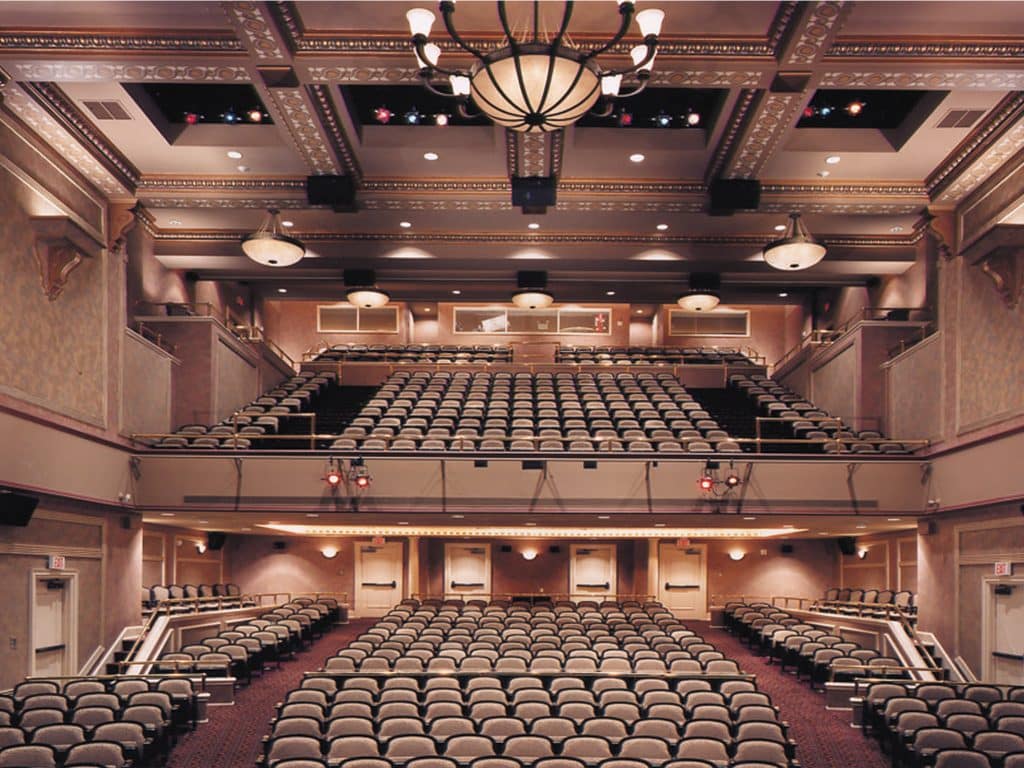
Great performing arts facilities don’t just host events — they become the cultural heartbeat of the communities they serve.
A performing arts center is rarely built for a single purpose. On a Monday morning, it might be a high school chorus rehearsing for spring competition. By Thursday evening, it’s a community theater’s opening night. On Saturday, a local symphony fills the hall. The building doesn’t change — but the people it serves, and what they need from it, shifts constantly.
This is the fundamental design challenge of modern performing arts facilities: how do you build one space that works brilliantly for all of them?
At EDiS, we’ve spent years working alongside schools, cultural institutions, and community organizations to answer that question. The answer isn’t a single building type or a fixed formula. It’s a philosophy of flexibility, grounded in deep listening and disciplined construction.
Multi-Use Performance Spaces: Flexibility as a Foundation
The most successful performing arts facilities we’ve built share a common trait: they were designed from the start to accommodate multiple configurations, audiences, and performance types. That means thinking carefully about acoustical variability — the difference between amplified rock and unamplified chamber music is significant, and a hall that only does one well serves its community poorly.
It also means building in physical flexibility. Movable seating systems, adjustable acoustic panels, retractable staging, and configurable lighting grids aren’t luxuries, they’re the infrastructure that allows a building to earn its keep across the full calendar year rather than sitting dark between big events. When a facility can pivot from a 400-seat proscenium performance to a flat-floor community reception without a crew of specialists, it becomes genuinely useful to the organizations that depend on it.
EDiS works with theater planners and acoustic consultants from the earliest stages of design to make sure flexibility is engineered in, not improvised later. We partner with local audio/visual and rigging/lighting subcontractors to utilize their hands-on knowledge when finalizing the design. They have decades of experience in designing, constructing, and troubleshooting theater spaces, making their recommendations an invaluable resource for achieving the best possible project outcome.
Backstage Areas and Performer Support Spaces: The Infrastructure of Excellence
What happens backstage is just as important as what happens in front of the curtain. Performers need spaces to warm up, change, store instruments, and decompress between acts. Production teams need organized storage, loading access, and technical support areas that allow for efficient changeovers between events.
In educational settings, these spaces carry particular weight. A well-designed green room or choir warm-up room isn’t just a convenience, it’s part of the learning environment. Students who rehearse and perform in professional-quality support spaces develop professional-quality habits and expectations. We take backstage programming seriously as a result, treating it not as leftover square footage but as integral to the facility’s educational and operational mission.
For community and regional venues, backstage capacity also affects the caliber of programming a facility can attract. Touring productions have technical riders. Professional ensembles have specific setup requirements. Building to accommodate those needs expands the range of what a venue can host — and by extension, what a community can experience.
Educational and Rehearsal Spaces: Where the Work Happens
The main stage is where performances happen. But the real work — the learning, the experimentation, the thousands of hours of preparation that make a performance possible — happens in rehearsal rooms, practice studios, and classroom spaces that often don’t get the attention they deserve.
EDiS approaches educational and rehearsal spaces with the same rigor we bring to the main hall. Acoustic separation between spaces matters — a brass ensemble rehearsing in one room shouldn’t bleed into a voice lesson next door. Proportional room geometry affects how musicians hear themselves and each other. Storage, instrument security, and sightlines for instruction all factor into layouts that serve teachers and students effectively.
When these spaces are designed well, they extend the facility’s impact far beyond performance nights. They become the daily infrastructure of a school’s arts program or a community organization’s year-round activity and they justify the investment in ways that a marquee event space alone cannot.
Community Accessibility: Designing for Everyone
A performing arts center that’s inaccessible — whether physically, financially, or culturally — isn’t a community asset. It’s a missed opportunity. Accessibility in its broadest sense should be a design principle from day one, not a compliance checklist applied at the end.
That begins with the physical environment: intuitive circulation, hearing loop systems, accessible seating integrated thoughtfully throughout the house rather than relegated to its edges, and restroom facilities scaled to actual audience demand. But it extends to the site itself — parking, transit access, drop-off areas, and the experience of arriving at the building for the first time should feel welcoming to everyone, regardless of familiarity with live performance venues.
We also think about accessibility in terms of programming flexibility. Lobby spaces that can host pre-show receptions, post-performance discussions, or standalone community gatherings extend the building’s reach into the broader public. Outdoor connections to plazas or campus green spaces create opportunities for informal cultural programming that draws in people who might never buy a ticket to a formal performance. The more ways a building can be used, the more people it serves and the stronger its case for continued public investment.
Long-Term Operational Considerations: Building for the Decades Ahead
A performing arts facility is a significant capital investment, and the organizations that operate them are almost always working with constrained budgets. That makes long-term operational efficiency not just a nice-to-have, but a genuine design imperative.
EDiS builds with operational realities in mind. Energy-efficient mechanical systems reduce utility costs that would otherwise consume programming budgets. Durable, maintainable finishes reduce the frequency and cost of ongoing repairs. Intuitive building automation systems allow smaller facilities management teams to operate sophisticated spaces without constant outside support.
We also think about adaptability over time. Technology changes. Programming needs evolve. A facility built today should be designed with infrastructure pathways — conduit, power capacity, structural provisions — that make future upgrades achievable without major reconstruction. The schools and cultural organizations we serve don’t have the luxury of rebuilding every decade. The buildings we deliver need to serve them well for thirty years, not five.
The Broader Value of Getting This Right
When a performing arts facility truly works — for students learning their craft, for community members experiencing live performance for the first time, for professional artists who need a venue worthy of their work — it becomes something more than a building. It becomes a place that shapes cultural life in a meaningful way. It’s where students discover a love of theater that stays with them for life. It’s where a community gathers after a hard year. It’s where local artists find a stage that takes their work seriously.
EDiS understands what’s at stake in these projects. We bring technical depth, genuine collaboration, and a long-term perspective to every performing arts facility we build because we know that the work we do doesn’t just construct buildings. It creates places that matter.


