


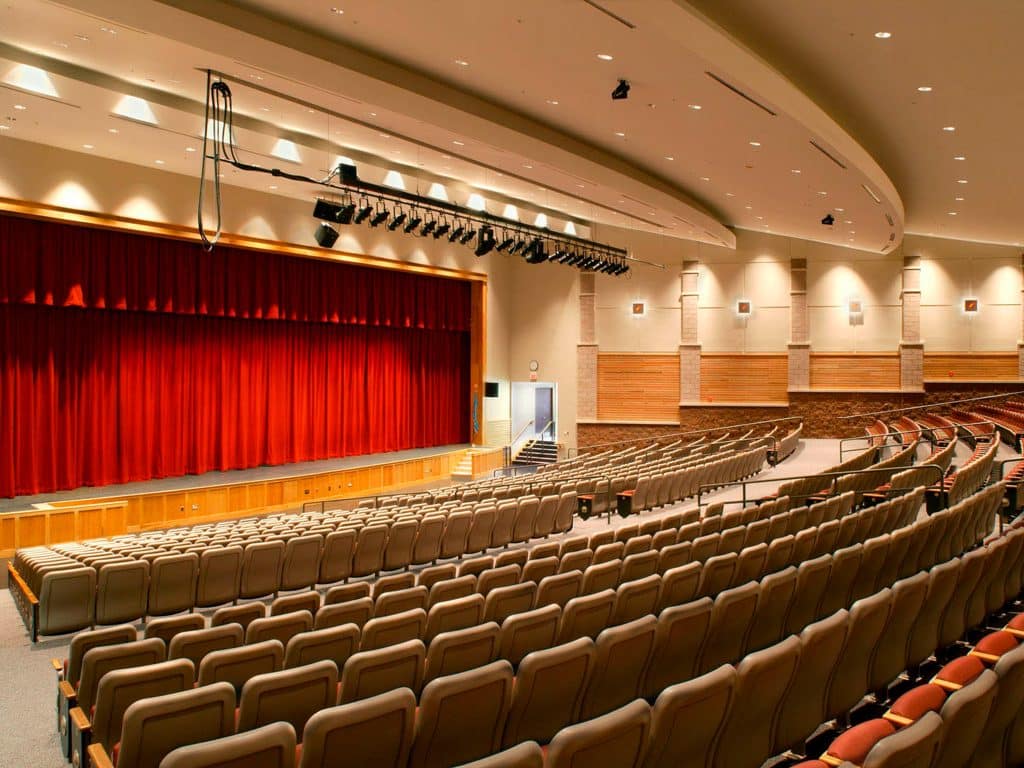
When the curtain rises on a world-class performance, audiences are transported — by the music, the drama, the lighting, the sheer experience of it all. What they rarely see is the extraordinary infrastructure that makes every moment possible. At EDiS, building performing arts centers means mastering a unique intersection of art and engineering, where precision construction meets the exacting demands of the performing arts world.
Here’s a look behind the curtain at the complex systems that define these remarkable buildings and the technical expertise required to bring them to life.
Stage Rigging and Fly Systems
Few systems in a performing arts center are more visually dramatic, or more technically demanding, than the stage rigging and fly system. Suspended above the stage are hundreds of counterweighted line sets, motorized battens, and specialty hoists that allow scenic elements, curtains, lighting rigs, and even performers to travel seamlessly in and out of view.
Construction of the fly tower — the tall structure above the stage that houses these systems — requires extremely precise structural planning. The tower must be tall enough to “fly” full scenic pieces completely out of audience sightlines, which often means building to heights two or three times the proscenium opening. And due to the fact that the fly space is often within the middle of the overall building, coordination of trades is vital to complete the fly space and its façade prior to constructing the rest of the building around it, making a good schedule and sequencing vital in this construction. Steel framing must be engineered to handle dynamic loads as scenery moves, while the floor grid above must provide access for riggers working at height.
Coordination between structural engineers, rigging consultants, and the general contractor is critical here — every embedded anchor plate, every catwalk, and every cable pathway must be accounted for before a single steel beam is erected.
Lighting and Audiovisual Infrastructure
A modern performing arts venue is essentially a sophisticated technology platform dressed in architectural splendor. The lighting and AV infrastructure that supports a single performance involves miles of conduit, thousands of circuit connections, and carefully coordinated equipment positions — all of which must be designed and installed during construction.
Lighting grids, front-of-house position booms, follow-spot booths, and dimmer rooms require structural support, electrical capacity, and maintenance access that must be built into the fabric of the building. Similarly, sound systems demand careful placement of speaker clusters, subwoofer arrays, and distributed audio zones — all tied back through dedicated AV pathways to a central control room.
The challenge for the construction team is ensuring that conduit runs, junction boxes, and structural blocking are all in place before walls close up — changes after the fact are extraordinarily costly. Pre-construction coordination meetings between the general contractor, MEP engineers, and AV/lighting consultants are essential to getting it right the first time.
Orchestra Pits and Stage Lifts
Flexibility is the hallmark of a truly great performing arts venue. A space that can host a full symphony orchestra one evening and an intimate theater production the next requires mechanical systems that literally reshape the room and that means orchestra pit lifts and stage extension platforms.
Orchestra pit lifts are manual, hydraulic, or electromechanical platforms that can be raised flush with the stage for extended playing areas, lowered to provide additional audience seating, or dropped further to create the traditional pit configuration for orchestral performances. The mechanical systems that power these lifts are housed in deep pits below the stage floor, requiring significant below-grade excavation and waterproofing during the early phases of construction.
Stage lifts and wagons — rolling platforms that carry entire set pieces — also require precision-engineered floor pockets, tracks, and support structures embedded in the stage deck. These systems demand the closest possible collaboration between the construction team and the specialty equipment vendors to ensure tolerances are met and the final result operates flawlessly.
Flooring
A good stage floor is paramount to providing a good, flexible performing space. The floor must be properly cushioned to muffle the sound of footsteps during performances. It should also be maintained on a completely level plane to eliminate tripping hazards and ensure stability, particularly for events that include dancing. Two or more layers of black painted Masonite are installed on top of the floor support system to provide a surface that allows for sets and equipment to be anchored in while being easily replaceable after a few years of set installations and removals.
Acoustic Panels and Sound Control
Of all the technical challenges in performing arts construction, acoustics may be the most invisible — and the most consequential. The difference between a hall that sounds transcendent and one that sounds flat or muddy often comes down to decisions made during construction that can never be easily undone.
Acoustic design begins with the shape and volume of the room itself — the angles of walls, the height of ceilings, and the curvature of balconies all influence how sound behaves. From there, absorptive panels, reflective surfaces, variable acoustic systems, and carefully designed HVAC silencers all play a role. Background noise levels in a performance hall must be extraordinarily low — HVAC systems, plumbing, and even elevator machinery must be isolated and quieted to levels far beyond what would be acceptable in a commercial office building.
For the construction team, this means following acoustic consultant specifications with exceptional precision — the correct mass of wall assemblies, proper installation of vibration isolation hangers on mechanical equipment, and meticulous air sealing of wall and floor penetrations. A single gap in an acoustic barrier can ruin years of careful design work.
Another option to consider during design is if an acoustical shell is desired on the stage. An acoustical shell is a modular, reflective structure that is placed around performers on the stage to redirect the sound energy towards the audience to enhance volume and clarity. It consists of convex structures attached to the rigging above and tall, mobile structures that are wheeled to place on the stage. Proper planning needs to be made prior to deciding to proceed with an acoustic shell, including providing a storage location for the tall structures and ensuring that there are available line sets (typically 3) in the rigging to support the ceiling shell structures.
Coordination with Specialty Consultants
What sets performing arts construction apart from virtually any other building type is the density and complexity of specialty consultant involvement. A typical performing arts center project may engage theater consultants, acoustical consultants, rigging engineers, AV/lighting designers, stage lift vendors, drapery specialists, and broadcast infrastructure consultants — all of whom must integrate their work seamlessly into the overall building design and construction sequence.
Managing this web of expertise requires a construction manager with deep experience in the building type and a commitment to proactive coordination. At EDiS, our approach centers on bringing all stakeholders together early during pre-construction so that conflicts are resolved on paper rather than in the field. We use Building Information Modeling (BIM) to coordinate the extraordinary density of systems in these buildings, ensuring that rigging hardware, conduit runs, HVAC ducts, and structural elements all coexist in their intended locations before construction begins.
The result is a building that works — technically, acoustically, and artistically — from opening night forward.
Building Where Art Comes to Life
Performing arts centers are among the most technically demanding and personally meaningful buildings a construction firm can deliver. They serve communities for generations, hosting the events that define cultural life — graduations, performances, community gatherings, and world-class touring productions alike.
At EDiS, we bring not just construction expertise but genuine passion for these projects. We understand that every technical decision — every acoustic detail, every rigging point, every lift platform — ultimately serves the artist on stage and the audience in the seats. That sense of purpose is what drives us to get the details right, every time.


