


The lab and life sciences sector continues to grow rapidly, bringing new demands for highly specialized research environments. From pharmaceutical development labs to advanced diagnostic facilities and hospital research centers, these spaces must be designed and constructed with precision, flexibility, and an understanding of complex building systems.
Laboratory environments require far more than standard construction practices. Mechanical systems, safety infrastructure, backup power, and strict environmental controls all play a critical role in supporting the research that happens inside these facilities. At the same time, many lab projects must be delivered within tight schedules, inside occupied buildings, or with minimal disruption to ongoing operations.
Across the region, EDiS has partnered with research institutions, healthcare providers, and life sciences developers to deliver facilities that support innovation and scientific advancement. The following projects highlight a range of laboratory and life sciences environments where thoughtful planning, coordination, and construction expertise helped bring critical research spaces to life.
3701 Market Street: Turn-Key Lab Space in the Heart of Philadelphia

Philadelphia’s University City neighborhood has become one of the most active life sciences clusters in the country. When GI Partners set out to develop a new pre-built laboratory and office space at 3701 Market Street, the goal was to create a turn-key environment capable of attracting leading research talent and supporting groundbreaking scientific work.
The 10,107-square-foot laboratory and office space on the building’s second floor was designed to provide a move-in ready environment for life sciences tenants. The lab includes a range of specialized features necessary for modern research, including:
- 36 laboratory benches with casework and sinks
- Four fume hoods
- Glass washing equipment and autoclave infrastructure
- Emergency eyewash and safety shower stations
- Cylinder storage and piping for tenant manifolds
- Dedicated backup generator
By combining flexible laboratory infrastructure with modern office space, the project created an environment where research teams could begin work immediately. The result is a space that not only supports cutting-edge scientific work but also strengthens Philadelphia’s growing reputation as a global center for life sciences innovation.
PMV Pharmaceuticals: Expanding Facilities for Breakthrough Cancer Research
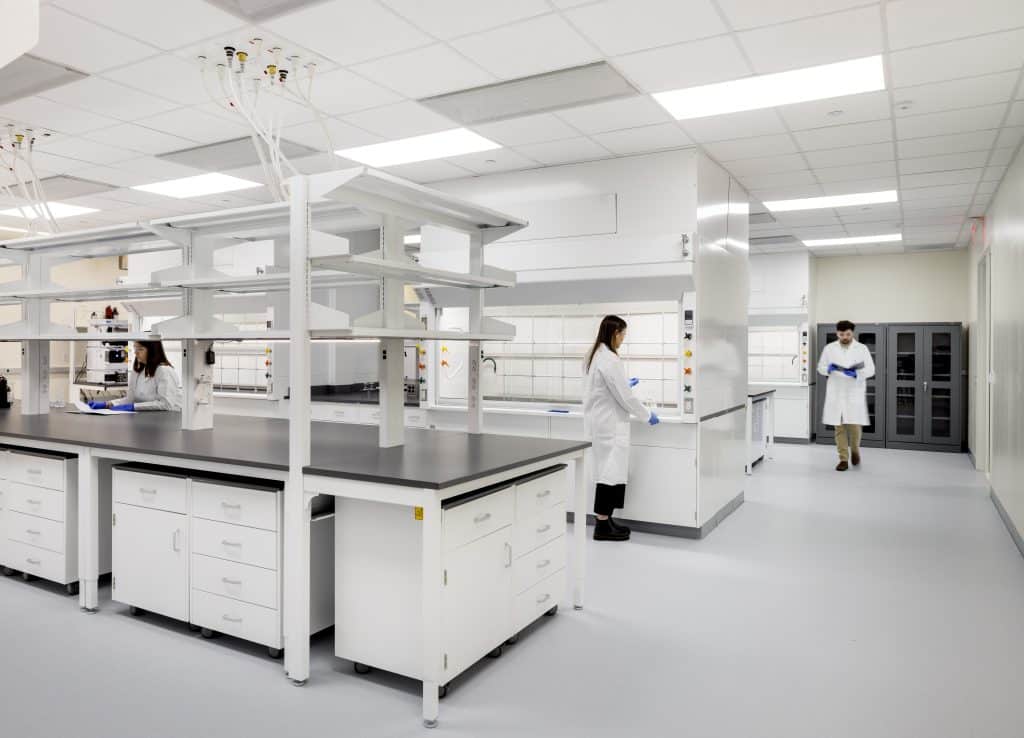
PMV Pharmaceuticals is dedicated to developing new cancer therapies by targeting mutant p53 proteins—one of the most important areas of research in oncology drug development. To support their expanding research efforts, PMV required a major upgrade and expansion of their laboratory and office facilities at One Research Way in Princeton, NJ.
The project was completed in two phases. The first phase focused on refreshing administrative areas with upgrades such as new flooring and finishes. The second phase involved more complex work, including demolition of outdated laboratory spaces and construction of new, state-of-the-art research environments.
Key elements of the project included:
- Installation of a new underground sanitary waste system
- New mechanical, plumbing, and medical gas systems
- Installation of a backup generator to support uninterrupted research operations
- Construction of advanced laboratory spaces tailored for pharmaceutical research
The completed facility significantly expanded PMV Pharma’s ability to conduct advanced research and development while providing a modern environment that supports both scientific collaboration and innovation.
Beebe Healthcare Cardiac Cath Lab: Construction Inside an Active Hospital

Healthcare environments often require extremely precise construction conditions, especially when work occurs inside an active hospital. When Beebe Healthcare selected EDiS to build a new Cardiac Catheterization Lab at its Lewes, Delaware campus, the project demanded exact coordination and careful execution.
The 3,350-square-foot project involved demolishing existing space and constructing a new cardiac catheterization lab along with supporting facilities, including a staff locker room and break room, linen room, and restrooms.
The project also included installation of medical gas systems, an uninterrupted power supply, and specialized equipment provided by Philips Healthcare.
One of the most complex aspects of the project was the location of the construction area. The new lab was surrounded by active medical facilities. Immediately adjacent were two operating Cardiac Cath Labs, while above the space were eight operating rooms. Below the project area were blood, pathology, and sterilization laboratories.
Strict controls were required to manage dust, noise, and vibrations while maintaining uninterrupted hospital operations. In addition, the floor had to be leveled to extremely precise tolerances to accommodate a specialized FlexMove x-ray imaging system used for full-body imaging.
Despite the technical complexity and sensitive environment, the EDiS team successfully delivered a highly specialized medical facility designed to serve patients and physicians for years to come.
Delaware State University COVID Testing Lab: Delivering Critical Infrastructure in Record Time
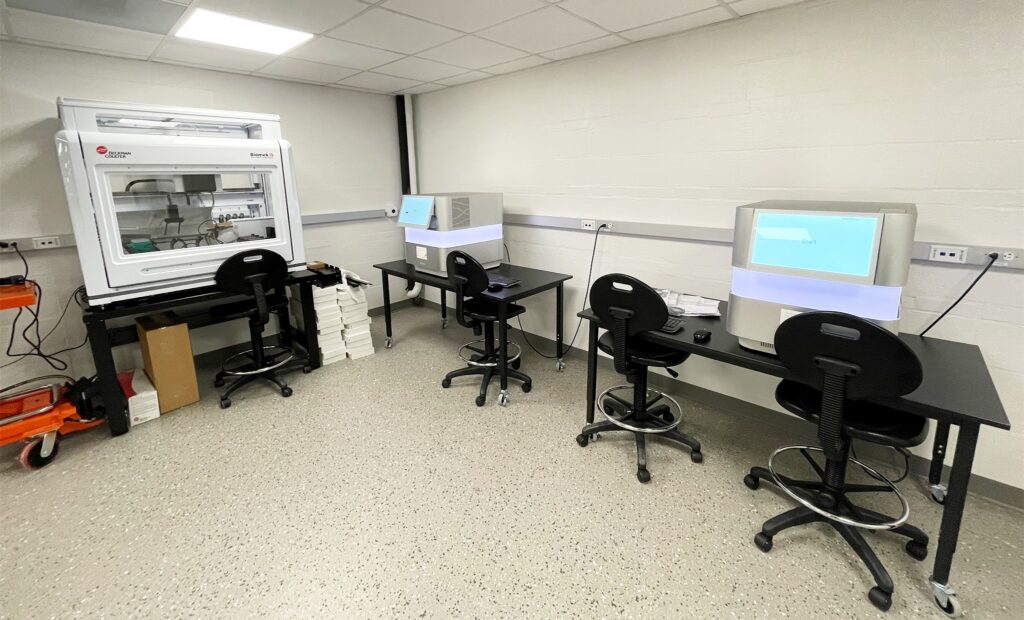
During the height of the COVID-19 pandemic, rapid access to testing became a critical public health priority. Delaware State University partnered with New Castle County to establish a new diagnostic testing laboratory funded by $5 million in CARES Act funding.
The new 4,900-square-foot laboratory was designed to provide affordable, high-capacity COVID testing for New Castle County, which at the time had the highest positivity rate in the state.
The project came with an extraordinary challenge: the entire lab needed to be completed in just five weeks.
The project included demolition and installation of new mechanical systems, walls, plumbing, ceilings, flooring, and roofing. Working alongside the architects, the EDiS team coordinated the rapid transformation of the facility while ensuring it met the strict technical requirements necessary for diagnostic testing.
Construction was completed in December 2020, with testing beginning the following month. Beyond its immediate impact during the pandemic, the lab was designed to support future diagnostic work for healthcare partners, including ChristianaCare.
Building Spaces That Enable Discovery
Life sciences facilities are some of the most technically demanding environments in construction. They must support advanced research while maintaining strict safety, mechanical, and operational requirements.
Each of these projects presented unique challenges—whether delivering laboratory infrastructure on accelerated schedules, working within active healthcare environments, or constructing specialized spaces designed for pharmaceutical innovation.
Through careful planning, coordination with scientific teams, and a deep understanding of laboratory systems, EDiS continues to help research institutions and healthcare organizations create facilities where innovation can thrive.
Because when the right environment is built, the discoveries that follow can change lives.


